


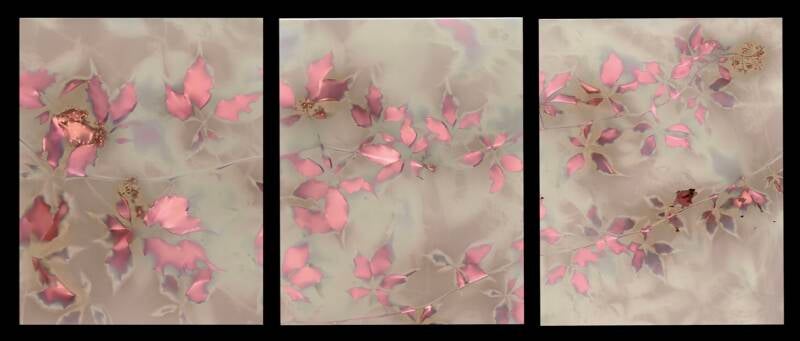
Several years ago I investigated the processes of Lumen prints and Chemigrams. This is the first of two guides this one features Lumen prints. (all the above prints were completed during 2020/2021 individual print size 10"x8").
Lumen prints are one of photography’s most quietly fascinating processes, an alchemy of sunlight, photosensitive paper, and time. At its core, a lumen print is a form of contact printing, made by placing objects often leaves, petals, seeds, textiles, or translucent materials directly onto black and white photographic paper under a perspex sheet to keep them flat and in contact with the photographic paper. Instead of developing the paper in chemicals, you simply expose it to sunlight. As UV light reacts with the silver halides in the paper’s emulsion, rich colours bloom: violets, russets, soft oranges, deep browns. These hues aren’t predictable, and each sheet responds differently depending on age, brand, humidity, and the intensity of the Sun,in my experiments I found I got the the best results from old out dated papers I bought from Mr Cad.
The process embraces chance. A leaf might leave behind acid etched shadows; flowers may stain the paper with their natural pigments; moisture can produce halos and solarised effects. Exposures can take minutes in bright summer conditions or stretch to hours on cloudy days.
Once the exposure is complete, the print is usually fixed in a traditional photographic fixer to halt further darkening unwanted exposure This “locks in” the image, although some choose to leave the print unfixed, letting it continue to evolve over time acknowledging the living, shifting nature of both paper and plant matter.
Lumen prints sit at the intersection of photography, printmaking, and natural science. They celebrate the transient moments in nature, recording the physical touch of leaves and flowers as much as their form. In an era of high definition screens and instant capture, lumen printing invites slowness, experiment, and attentive looking. It reminds us that images can still emerge from the simplest interactions, paper, light, time, and the quiet forms of the natural world.
The Technical Foundations of Lumen Printing: Materials, Chemistry, and Process
Lumen printing is often described as simple, but beneath the apparent ease lies a complex interaction of chemistry, light, moisture, and photosensitive materials. Understanding these mechanisms allows artists to push the process further and gain more predictable or deliberately unpredictable results.
Photosensitive Paper and Emulsion Chemistry
Lumen prints use silver gelatin photographic paper, usually resin coated (RC) or fibre based. Although designed for traditional darkroom development, its emulsion is responsive to ultraviolet light without chemical developers.
The emulsion contains:
- Silver halide crystals (typically silver bromide or silver chloride)
- Gelatin binder
- Sometimes anti-fogging agents and sensitising dyes
When exposed to UV light, silver halides undergo photolysis, reducing to metallic silver. Unlike regular black and white development which uses alkaline chemicals to amplify this reaction the lumen process relies on the slow, direct action of sunlight. This produces colours rather than greyscale because:
- The gelatin swells and partially denatures with heat
- Silver halide breakdown can produce chromatic byproducts
- Humidity and plant juices (alkali or acid) introduce additional compounds
- Older or expired papers often shift toward purples, oranges, and reds
Each brand and age of paper has unique behaviour. Fibre papers generally yield deeper tones, while RC papers often retain sharper silhouettes.
Object Placement and Material Interference
Objects placed on the paper act as physical masks or chemical agents. If using light materials such as leaves or flowers Cover the objects with glass or perspex.
Physical Masks
Opaque objects (stones, seeds, thick leaves) block UV entirely, leaving pale silhouettes. Translucent materials thin petals, onion skins, tracing papers allow graduated exposures that create soft tonal shifts.
Chemical Agents
Organic materials can chemically interact with the emulsion:
- Moist leaves release acids that accelerate silver halide breakdown
- Flower pigments can stain or dye the gelatin
- Salt crystals or vinegar produce solarisation like effects, these can be scattered or sprayed onto the paper.
- Soap bubbles leave surface tension rings
- Metal objects may catalyse localized oxidation
Moisture amplifies chromatic reactions; dry materials produce cleaner outlines.
Exposure: Time, UV Intensity, and Environmental Variables
Several variables shape a lumen print:
1. UV intensity
Direct summer sunlight can produce strong reactions in 5–20 minutes, while weak winter light may require 1–3 hours. Cloud cover introduces softer colour transitions.
2. Temperature
Heat accelerates gelatin softening and promotes more dramatic colour shifts. Warm surfaces can deepen reds, ambers, and browns.
3. Humidity
High humidity slows drying, allowing organic juices to spread. Conversely, dry days keep the image crisp.
4. Airflow
Wind can lift lighter materials, creating ghosted double images. Weights or glass sheets help anchor compositions.
Most artists work under a pane of picture-frame glass to:
- Maintain contact
- Prevent curling
- Reduce atmospheric contamination
- However, printing without glass encourages chaotic effects such as light bleed, shadow double-exposure, and pigment transfer.
Fixing and Archival Considerations
A crucial stage is deciding whether to fix the print.
Fixing
Using standard photographic fixer (sodium thiosulfate or ammonium thiosulfate) removes unexposed silver halides, permanently halting the photochemical process. However, fixing often causes a dramatic colour shift: purples may become browns, oranges may deepen to umber. Toning before or after fixing (selenium, gold) can help stabilise pigments.
Unfixed Prints
Leaving a lumen print unfixed preserves its initial colours but sacrifices archival stability. Unfixed prints can darken significantly over weeks, months, or years. Some artists scan the unfixed print immediately to preserve the original chromatic intensity.
Washing
After fixing, wash fibre papers for 20–30 minutes to remove thiosulfate residues; RC papers require less time. Inadequate washing can lead to yellowing.
Advanced Variations
- Wet lumen prints: adding water, salt, soap, or ice creates unpredictable patterns.
- Combined chemigrams: painting developers or bleach on the paper before exposure.
- Lumen photograms: precise geometric masking using stencils or transparencies.
- Digital hybrids: scanning high-res lumen prints and enlarging them for exhibition.
Conclusion
While simple on the surface, lumen printing is a sophisticated interplay of chemistry, material and environmental conditions. Mastery comes not from rigid control but from understanding how light, paper, organic matter, and time interact and allowing space for the unexpected to take shape.
Please use caution when using photographic chemicals and follow the instructions on the packaging.
©️images and content Graeme Webb 2025
Add comment
Comments
A remarkable process, with endless results Graeme,I have seen and heard about this art,but your explanation is something very special, thank you